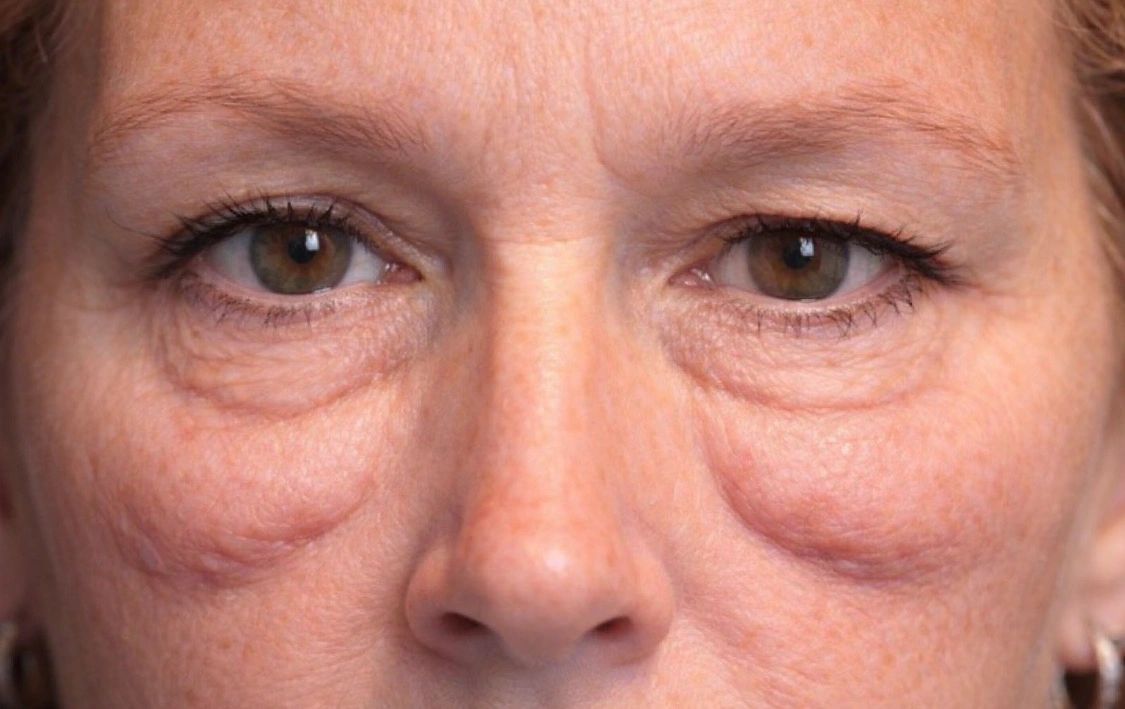
Festoons: What Will Actually Help?
And What Can Quietly Make Them Worse
Festoons — the soft, sagging fullness that appears between the lower eyelid and the upper cheek — are one of the most frustrating under-eye concerns for patients and practitioners alike. They're also one of the most commonly misunderstood.
Many people are told that lasers, radiofrequency, or eye creams will solve the problem. Others see brief improvement, only to notice that their skin looks thinner, crepier, or more hollow a year or two later.
The reason is simple: not all festoons are the same, and not all treatments respect the biology of the under-eye.
First, Understand What's Actually Causing the Festoon
Festoons typically come from one of three things:
- Loosened, sun-damaged skin
- Laxity of the underlying eye muscle
- A combination of both
This distinction matters, because skin treatments can only help skin problems. They cannot correct muscle laxity or deeper structural issues.
A Few Simple Ways to Tell the Difference
Look closely at the skin
If the skin appears thin, crepey, wrinkled, or fragile — especially if it looks like loose fabric rather than a firm bulge — the issue is often skin laxity. These cases may respond to skin-tightening treatments.
If the skin looks smooth but sits over a thicker, shelf-like bulge, the issue is more likely muscle or structure.
Gently press the area
If the fullness compresses easily, moves side to side, and feels soft, skin laxity is likely contributing. If it feels firm, rebounds immediately, or barely moves, muscle laxity is more likely involved.
Watch what happens when you smile
If the bulge becomes significantly more pronounced with smiling or squinting, muscle involvement is usually present. Skin-based issues tend to look similar at rest and in motion.
Treatments That Can Help — and Treatments That Can Hurt
For festoons involving skin laxity, the key is to build the skin — not to thin it further.
Approaches that improve skin quality without destroying tissue can reduce festoon prominence over time: LED therapy, regenerative serums, and skin-building protocols that increase collagen density and improve barrier function without heat damage.
Approaches to use with great caution in this area include radiofrequency, ablative lasers, and any modality that relies on thermal damage to stimulate collagen. In the under-eye, where skin is already thin and vascular, heat-based treatments can exacerbate hollowing, compromise the barrier permanently, and create changes that are difficult or impossible to reverse.
The under-eye is not a forgiving treatment zone. What looks "stimulating" in marketing can look depleting in this delicate area 12 months later.
What We Recommend
At South County Microspa, we approach the under-eye with a biology-first philosophy. Before recommending any treatment, we assess whether the festoon is skin-based, structural, or both — because the wrong treatment can quietly worsen what it claims to correct.
For skin-based festoons, we build. For structural festoons, we counsel. And for those who have already experienced thinning or hollowing from prior treatments, we focus on regenerative repair — restoring what was there before, not adding more of the wrong thing.