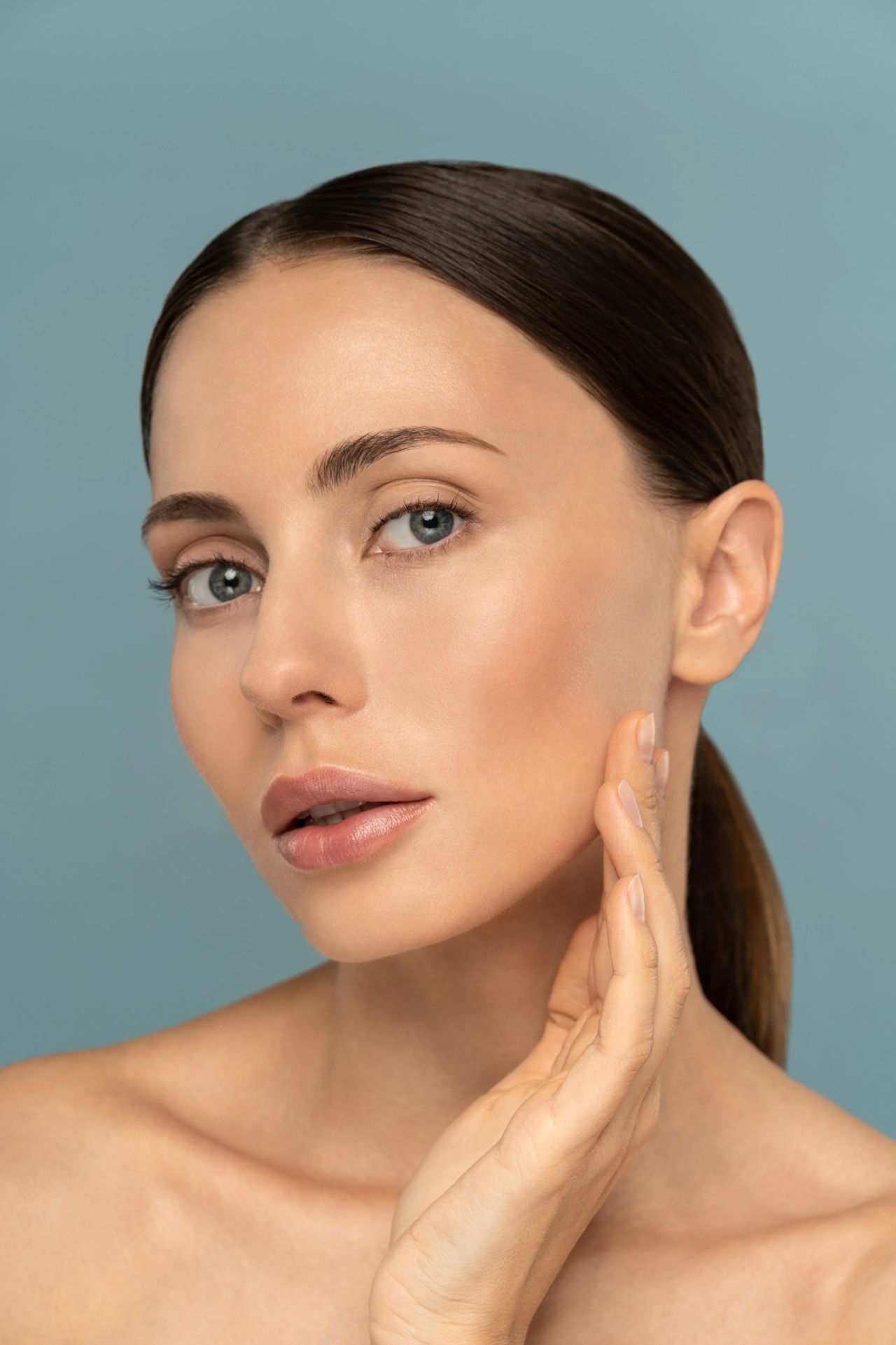
Beyond the Facelift
The Evolution of Facial Rejuvenation
By the time someone considers a facelift, they've often invested years in maintaining their skin health. And to be fair, a beautifully executed lift can be transformative — redefining contours, restoring jawline structure, and repositioning what time has softened.
Yet even the best surgical artistry can sometimes fall short of the desired outcome, particularly in the area most people most want to see smoothness: the delicate zone between the nose and the jawline.
The Facelift's Quiet Limitation
This is not a flaw in technique — it's a structural limitation of the face itself.
To surgically tighten this intricate area would require incisions under the nose and around the lips, which most surgeons wisely avoid due to the risk of visible scarring and altered expression.
As a result, the skin around the upper lip, chin, and perioral region often remains slightly lax, even after an otherwise successful lift. These are also the areas where the skin is thinnest and most expressive — and therefore most prone to fine lines, texture changes, and loss of elasticity over time.
Why CO₂ Laser Is Commonly Added — and Why It Falls Short
To compensate, many surgeons recommend CO₂ laser resurfacing as a "finishing touch" a few months after surgery. The idea is to smooth what the scalpel cannot reach.
While well-intentioned, this approach rarely provides a long-term solution.
CO₂ may temporarily refine the surface, but it cannot rebuild the underlying architecture of the skin. It doesn't restore the dermal matrix or reverse the cellular aging that caused the texture change to begin with.
And its results are not lasting. The skin may appear fresher for a time, but the deeper support structure remains weak. Over time, the effects fade — sometimes leaving behind sensitivity or pigment changes from the very resurfacing meant to correct them.
The Myth of "One and Done"
For years, the aesthetic industry has promised "one-and-done" solutions — single procedures that could erase years in one sitting. It's an appealing idea, but it has led to overly aggressive treatments that often do more harm than good.
The reality is simple: you didn't age overnight — and you won't anti-age overnight either.
But you can reverse visible aging and slow it down going forward. The key is to work with your biology, not against it. Skin is a living, adaptive organ that thrives on consistent stimulation and repair. Real rejuvenation comes from progressive regeneration — treatments that rebuild the dermal matrix, improve circulation, and support collagen turnover in rhythm with the body's natural renewal cycles.
A Regenerative Answer
At South County Microspa, we've developed a proprietary approach that truly addresses the problem a facelift cannot reach — offering results comparable to a light facelift, with little to no downtime.
Our approach doesn't pull or stretch the skin into a new position; it shrinks it naturally in place, restoring the contours nature designed. As the skin gently contracts, it simultaneously rebuilds its internal scaffolding — regenerating collagen, elastin, and the dermal support fibers that give youthful skin its smooth, resilient quality.
This isn't surface-level change. It's true rejuvenation at the structural level — returning the skin to a younger biological state, not just a younger look.
And unlike many trending treatments built on marketing claims, ours is grounded in medical research, clinical observation, and measurable data. It's not hype — it's physiology.